Jai Verma
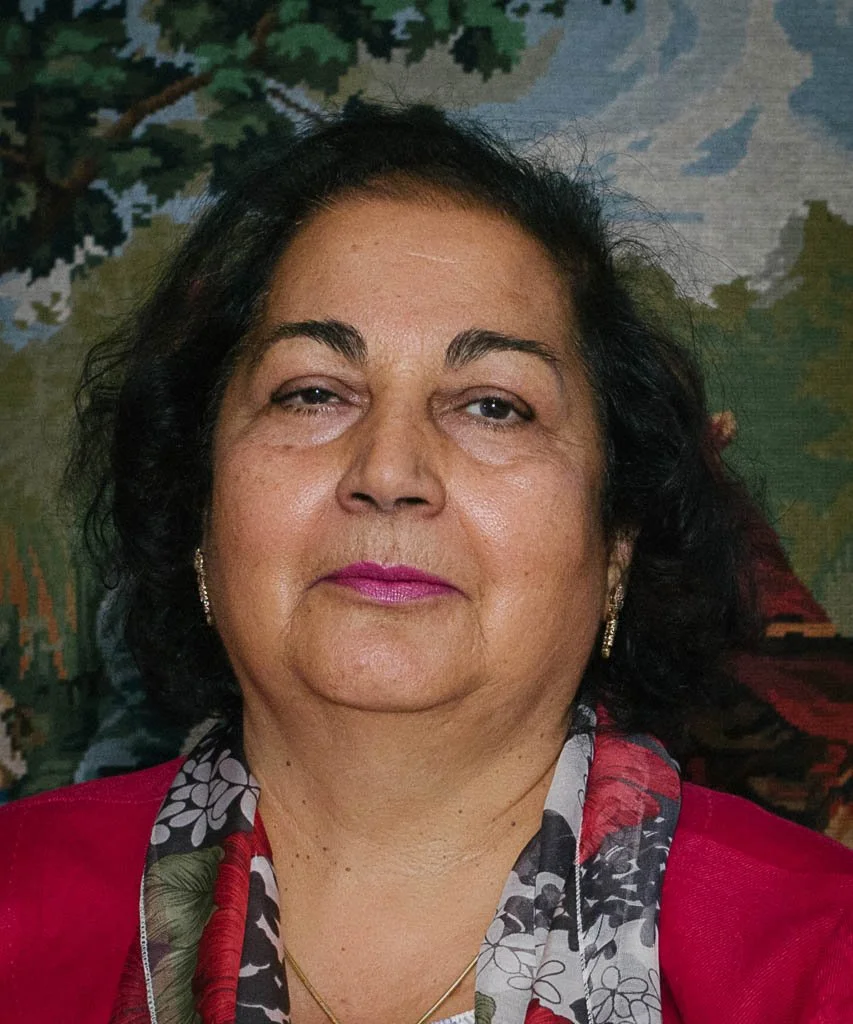
I’ll show you a photo of the first time I wore a sari. His granddad, he liked me, he was 82 years old, Granddad. He wanted to take one of my photos to show it to him. We had never met before the marriage. We only met after the marriage. So then I wore this, and then they said, “You have to wear a sari.” I said, “No, I don’t want to get married, first of all, and secondly, why should I wear a sari?”
It was not a painful thing, really, I tell you this. We were not unhappy the way we lived in those days, with a limited pay. Though it was a challenging life, I must say. You have to learn everything. I didn’t know how to cook or live this life, or run the household. But you learn, really. You learn very quickly, and because here life is easy, really, comparatively.
Luckily, what happened, we got a house, so we were all right that way, but doing the housework, cooking, cleaning, washing, no machine, no washing machine.
As I could, because I had done my B.A. Same thing when I was doing English Literature – I couldn’t work out what “pie” was, because in David Copperfield, he stole one pie from the cupboard. We used to say, “What is pie?” We needed to look in the dictionary.
I knew the English, but we spoke our own language, and we lived in our own city and with our own friends and families. So we didn’t know much about the world, really. But when you come here, the world was open, and then instead of floating, you have to learn to swim.
We didn’t think about much in India, really. Because when we were there, you think about India, your relatives only really. There’s always weddings happening, weddings or festivals, and lots of family events. You don’t have a need to go anywhere. Even in the summer holidays, you used to go to Nani’s house, or your Bua’s house, or your auntie’s house, that’s it really – and we used to look forward to it. There was no such thing [as travelling widely].
Some people did [travel abroad earlier]. I mean, his family did. His Nanaji, who found me and who selected me for him, he was a captain in the Army, and of course he must have been in the First World War, really. Nanaji must have been. His Nanaji was his Mama’s… [relative]. His son then fought in the China war. So first World War, second World War, and the China war – three generations were in the army. My husband did not join the army. Then the army life finished after three generations.
That’s why I was talking to Ron the other day. I said, because his family were involved with the two world wars, it would be very interesting to get some kind of record, because they have a lot of medals and everything. You can even get the photos.
It’s amazing, really. There are a lot of people from Meerut who are rebellious people. They are like Nottingham people. I live in the city of Robin Hood, and I come from Meerut, both rebellious places. There is a burning desire to make India free. But where do you go? What do you do?
They did worry about it, really, and they felt sad about it, which shows the humanity.
There are Gorkha people too. There are Gorkha regiments here as well, actually, in England.
You’re sitting nicely, you’re not writing down, scribbling notes. [laughs]
Later on, he got a job in Gateshead in the North. I could not understand Geordie. And actually, now, 40–45 years later, I would like to go to Newcastle. I have not visited Newcastle since then, but really, now I would like to go to Newcastle and listen to people and see if I can communicate with them and understand them, and they understand me. I don’t know.
He used to work in South Shields. Yes, we used to go there, to North Shields and South Shields. The sea and the coast and the other side – it was very, very friendly people. Actually, they were very friendly people, I must say.
But I remember the very first day, if I can tell you the incident. We didn’t have net curtains in our house, and that was the fashion in those days. From India, it takes a few days for things to arrive, and it was my first journey abroad. I had never been abroad before. And when I opened the door, a little cheeky girl, all rosy in her cheeks, she had a smile on her face, beautiful-looking girl. I could not say anything. And what she was saying, I had no idea, but she was talking Geordie. I didn’t know she was trying to give the curtains to me, and I didn’t realise what she was saying. In the end, I took the curtains, luckily. I remember a little bit of him saying that the curtains would come tomorrow, and that’s it.
Then he phoned after a few minutes, and they said, “Have you received the curtains?” I realised, oh, that’s what she was saying. So the language was English, but I couldn’t recognise it as English.
Even now, I’m sure they must feel the same way about him, what he was saying, because one day I was having a conversation with my son’s friend’s mother. These three boys had gone to Australia after graduating. They used to send messages, because those days there was no internet, no email, no mobile phones like today. So they used to send messages to one family, and then we used to phone each other.
One day, I was talking to his friend’s mum from Newcastle, and my son said, “Mum, I’m sure it must have been difficult for her to understand you.” I said, “I don’t know, maybe it was more difficult for me.” But we didn’t find any difficulties because we had a common cause – our sons – and then it was not difficult for me to understand her, and I’m sure it was not difficult for her to understand me. He said, “But Mum, really – Indian and Geordie accent!”
When we came to Nottingham, we came to a place where I found the Hindu temple, the Indian Women’s Association, and Carlton Road. It was not on Carlton Road in those days; it used to be in someone’s house. later it moved. The temple that is now near New Art Exchange, down towards the Al-Freton Road – one of the houses there is Dr Bhatia’s house. He was a committee member and one of the pioneers who wanted to have a Hindu temple. And then he gave one of his houses. He still owns the house – it’s like a rented house – and they lived there. So slowly we had a place together, really.
We used to have a community centre, internationally linked. Mahindra – she is the head teacher of the Hindi school – and I took my kids there. She said to me, “Oh, you speak very good Hindi.” I said, “I come from Meerut. Hindi is my mother tongue.” Then she said, “Are you going to stay when the children are studying?” I said, “I can go home and come back.” She said, “No, stay here while they are here, settle them down.” So I went for a couple of weeks, Saturday mornings. Then she said to me, “Would you like to teach Hindi?” I said, “I’m not a Hindi teacher.” She said, “No, we’ll help you.”
Since my children were there anyway, instead of going home and coming back, I thought I’d better stay. And then I started teaching Hindi. I did that for 15 years. Later on, we didn’t have much material, so we wrote it ourselves. Whatever we remembered. We have got 31 books. We translated them from English to Hindi. The Language Centre gave me the job, then they made me the coordinator in the Language Centre. So we all used to write the stories – like Piasa Kaua (The Thirsty Crow), or Sher aur Lomdi (the Lion and the Fox), and the race – they are stories from the Greek stories we used to read translated into Hindi in India. So whatever we remembered, we rewrote.
I’m glad they are about, and children were learning. There was also Indian dancing – proper Indian dancing. So I was very much settled straight away, really. The Hindi school has been a very instrumental thing, really, for me and for the community.
This must have been in the 1970s. The Carlton Road building [for the temple and associations] came later. When it was built, it was actually a big thing, and then we had the launch of the heritage [project].
In those early days, there was no temple anywhere in Nottinghamshire. Later on, more temples were opened. Today we have four temples in Nottingham. The one on Forest Road was mainly sponsored by Tamil people or Sri Lankan people; they contributed a lot.
So it’s good – we’ve got choice nowadays. But we are still attached to those early places where we started.
At that time there were very few facilities. For example, in our surgery – no proper seating arrangement. When you see surgeries nowadays, they are like five-star surgeries. But those days, when we inherited the practice, there was nothing there: no heating either. People used to sit on a bench. Only one receptionist was working.
The area has changed so much. At that time, there used to be the Raleigh factory there, next to our surgery on Raleigh Road. Now it’s the university hall of residence. In August they used to have two weeks’ holidays – you would not see a car. Nottingham factories used to close for the last two weeks of August.
Raleigh factory is not there now. It’s all changed. But the road names are still there – Triumph Road, Raleigh Road, all are still there.
A lot of things are happening; it’s a budding area really. Like Gregory Boulevard now – when you go in the evening it’s so much alive after six o’clock, when other shops are closed, but the Indian sweets and the groceries and everything are open: Mughals, Sherif, the Royal Sweet House, Jam Jam and all that. And the jewellers on Radford Road.
Jam Jam Yummy – that one, yes! It has changed. A lot of dress shops – clothes and saris, all these things have come up. Otherwise, we used to go to Leicester to do shopping. We still do sometimes, but not that much, because everything is available in Nottingham now. Most things we can get in Nottingham now.
Barry’s Road West is a very historic street. People are travelling a lot, and nowadays you can buy on the internet. So the market has changed, really, and the Bollywood fashion is there.
In those days there was only one cinema – Leno – in NG7. It was on Radford Road near the police station.
Interviewer:
It used to be Leno Bingo Hall.
Participant:
Yes, there they used to show the films. Every Sunday, two films for the price of one. You buy one ticket and you see two movies, and then you buy some samosas and gathiya and everything. It used to be really family time. Then you met Indian families there, which we wouldn’t know otherwise, where they lived. Everyone used to meet there. It was very good, yes.
And now look at this – the Bollywood movies are shown in the Showcase [multiplex]. It’s amazing how it has come up now really, because even people who don’t know Hindi still want to see Hindi movies. They still listen to the radio and listen to Hindi songs, even though they don’t know the language, by attraction of the Bollywood movies.
One day we were in a taxi in London, and the taxi driver, as soon as we sat in the taxi, started putting Hindi songs in his car. He did not look Indian. So I asked him which country he was from. He said, “Oh, I’m from Afghanistan.” I said, “Do you watch Hindi movies?” He said, “Yes, I do. I listen to them because of my wife. She watches everything. She sees all the serials and everything. They are all in Hindi, and she does not miss any of them.” So he straight away knew that we were Indians, and he put Indian music on in London.
Same thing happened when we went to Morocco and other countries. They all know Hindi songs, old Hindi songs. They say “Amitabh” straight away, “Raj Kapoor”. It’s amazing – Bollywood movies have gone everywhere. Bollywood has done a great thing for Hindi really; they have spread the language everywhere, and the fashion and the culture. Sometimes I don’t see it as a good culture what they are showing nowadays. I wish there was more control.
I don’t see anyone wearing saris or decent clothes in many of the films – the girls are wearing less and less clothes, really. Things have changed. I could not imagine in our time, even in the 60s or 70s, so much drinking, really. And they are even crossing the line of British films. In British films, if you have children, you go by certificate – up to 12, then you have different kinds of movies. But in the Hindi movies, they have no barrier, no control. You are sitting with your family and it is embarrassing sometimes, really, what you see.
They used to say that there was very strict censorship. But looking at these movies, I don’t think they have. I don’t know what has gone wrong, what they are trying to show. I can understand that people see in the movies and think it is real, though it’s not real. Actually, when you go to India, you don’t see the society they are trying to show you in the movies. Maybe in big cities, but not everywhere. Why spoil the young people?
I don’t see young people wearing saris, young girls, or Indian outfits, or any decent clothing, or doing housework. They don’t do embroidery, they don’t do any crochet, or any kind of things, or cooking. They only go either to the night club or have fast cars or wear less clothes and sing and drink. That’s what in the culture they are showing. But that’s not Indian culture, really, and it’s not reality either. They should project our culture, really, not only Western influence.
In the old Leno days, only Indians and Pakistanis came – mostly Indians, Punjabis, Gujaratis and other parts of India. It was family fun, really, because you go there – I don’t think you saw much of the film, but you ate samosas and gathiya and pakora and everything and met everyone. We used to take some packed lunch as well.
Some religious films too. Jai Santoshi Maa – that movie came, and people would just cover their head and sit with such shraddha and samarpan that it was like a temple. That was a gold movie, really. People used to throw money as well.
Same thing happened with the Ramayan TV serial. Even in India, they used to stop the traffic, and people would not go to work. They would just sit there. Mothers and aunties would take a shower, get ready, wear their saris, and sit like this every time while they were watching the serial. Such faith in India, really – which is wonderful. It gives them strength.
Nottingham itself has changed a lot. Factories closing, manufacturing turning into something else. There are now several surgeries in the area – one on Nottingham Road, one on Forest Road West, one near the high school, another near Lenton where Sainsbury’s is.
The area is very well developed really, when you see the shape of the houses and the architecture around Forest Fields and the Forest Ground – beautiful houses. That shows the grandeur of the past, how Nottingham was built. Later on it changed, and now it’s developing again.
The Goose Fair used to be there and is still there. And the New Art Exchange building was built. It looks different in the area – you can tell with the black building. We are members of it, and we know everyone. We go for the programmes – that’s all we can do. Nottingham Asian Arts Council and New Art Exchange – they work on lots of things side by side.
Nottingham was not like this when we came. Taxis developed; mostly taxi drivers used to be Indian. There were about 700 taxis at one time, I think.
There used to be a tram before – I have a photo from 1932 of Nottingham. I found them in an auction one day and bought them. There were trams then. Trams were taken out, and now they’re back again. I think Nottingham will not be without a tram now. It’s going everywhere.
They had planned to put the tram on the 52 route, but they didn’t. The 52 bus is so busy every morning going from here to the QMC. The Queen’s Medical Centre – that is NG7 as well. It was built in 1975. There used to be lots of hospitals in Nottingham – the Women’s Hospital, Mapperley Park Hospital, City Hospital (still there), Children’s Hospital, and the casualty at the Ropewalk. They all moved to Queen’s Medical and made it like a city itself. I don’t call it a village now, I call it a city – it’s too big.
The university is changing so much, really. There is Trent University as well. Many halls of residence everywhere. There are a lot of students coming, so that’s why they are linked with India really, because there are lots of Indian students there. The Vice-Chancellor of Nottingham University lives two houses away from us. We are number three.
They have a lot of links with China now, and now they’re getting connection with Chandigarh as well. The Vice-Chancellor keeps going to China; his wife keeps telling us, “He’s in China.”
I remember getting our son’s Raleigh bike for the first time from Triumph Road, and now Triumph Road is the university buildings. They are so unique, all of them, beautiful buildings and all different – science labs, the MBA building. My daughter did an MBA there. I used to take her, and every time I went there was a new building in a new shape. When tourists come, they want to see the new campus as well.
Nottingham itself – I must say – is a very good city, really. It is very environmentally friendly. There are lots of gardens, parks, lots of trees. The city life is good. One thing: in 1971 the Victoria Centre was opened. There were no malls in those days, no culture of malls. When the Victoria Centre opened – I remember when we came in 1976 – our friends from Sheffield and Birmingham used to come and see the Victoria Centre. They had the Bull Ring in Birmingham, but they still came. They’d say, “Oh, there’s a clock tower there, we will come and see Victoria Centre, do our shopping.” Till Meadowhall opened near Sheffield, people came from Leicester, Sheffield and Birmingham to shop.
Nottingham has maintained the art centre, the contemporary museum, Nottingham Castle – and they’re all improving really. Nottingham Castle got a lot of grant, and they are going to uplift the face of the castle, rightly so, because people want to come and see the Robin Hood city. Though some people in Doncaster and Sheffield say Nottingham is not the Robin Hood city – it’s their area. They even had an airport called Robin Hood Airport in Doncaster to make their point. [laughs]
I used to do painting as well, and I don’t know how it happened that I started writing. First, when I was teaching Hindi, we had to write children’s books. We had to prepare our lessons, and we didn’t have any material. No one was giving us help. Teachers – all of us – used to get together, do our work, make our lesson plans. We would say, “Go and write a story.” But what do you write? Whatever you remember – fruits, relatives, family, all these things.
Later on, the creativity started. We did 31 books in a group, a team of seven teachers, and made a full syllabus because Nottingham County Council had a project called Section 11. Under that, they asked us to write books. We didn’t think it was our right or anything. We never showed any ownership, really. We just wrote.
Some of our friends used to say, “You only work on Saturday morning for Hindi school; how come you’re working now?” We didn’t know – we just enjoyed it. We used to visit German classes, French classes, sit there quietly, see the children’s behaviour and their work. Then the Language Centre brought this project later on and gave me the job of coordinator.
All these books were done, but they were not printed. So how do you give them to teachers, to students, unless you make copies? There were no computers then – no email, no network. We weren’t linked with India or anything. We used to get books from India, and sometimes they were out of date. Children would not understand what gobar is if you say Sheila is doing the gobar-leaping. Or taking the hal in your hand – Ram ne hal chalaya – they wouldn’t know.
So we had to “Indianise” English storybooks – Alice’s Wedding became Meera ki Shaadi; Mohan ke Daant Mein Dard – a visit to the dentist; Ram aur Rajan ki Gaon ki Yatra showing relations. That’s how the creativity started.
Then I worked in the NHS for 25 years. I went to Clarendon College, then Broxtowe College, did my BTEC in Business and Finance. Later on I did further courses. One teacher used to say, learning is very different here than in India. Our teachers used to teach us there; here we are finding out for ourselves. It’s a very different type of education – very enjoyable – and you learn more.
We did an Employment Law project – four of us – and wrote a book. So writing was happening without realising. I didn’t think I was a writer. First we wrote the books in the Language Centre, then the employment law book. Then there was a course on coronary heart disease, and a course on “writing for publication”. Without realising, I joined that as well.
One day, sitting in class, the teacher was telling us how to write, what to write, what not to write. I started writing – in Hindi. Everyone was being asked what they wrote, and I said, “I’m sorry, but I wrote in Hindi.” She said, “That’s good, very interesting. That’s the language you know.” She wanted to hear it, even though others wouldn’t understand – she said she wanted to hear the sound of the words.
Then I wrote an article in Hindi, then a speech for a friend’s silver wedding anniversary. Then one day I wrote poems in Hindi. It was a very cold winter, 2000, I think. I wrote two poems; there was no heating in the house, the builder was working. I was upstairs, my husband downstairs. I said, “Do you know I wrote a poem?” He said, “That’s good.” I read it to him; he said, “Very good.” I thought he was just saying it.
Then my friend said, “Read it at the Indian Women’s Association tonight.” I said, “No, it’s not that good.” She insisted. I read both poems and everyone clapped. That’s how I started writing.
This year, in March, I had my book of short stories published – a collection of seven stories. One story from that book is in the University Grants Commission curriculum in India – it can be read anywhere in the universities. So these are the books: they were English books, we Indianised them. One is Haathi ki Kahani (Story of the Elephant). There were no computers; the covers are still in my handwriting, photocopied. We had one typewriter – our priest from the Hindu temple used to type for us.
They gave us an artist, Ian Brindle. I saw his name the other day on the back page of something. These are the people who were involved in creating these books. I put his name on Facebook and found he was already my friend there. I haven’t seen him for 27 years.
There was a project that “poetry is good for the mind, good for mental health” – poetry and painting. An English poet, Dave Wood, used to come to our surgery. He would sit in the waiting room every week or two, read poetry to the patients. One day I said, “Would you like to listen to Hindi poetry?” He said yes. Our staff told him, “Mr Verma writes poetry in Hindi.” He asked me to read. I resisted at first, but then I recited. Patients were very happy. Dave joked he might lose his job if I kept reading in the waiting room. [laughs]
I read one poem on Sunrise Radio at 11pm in their poetry session. Someone in Birmingham heard it and recognised my husband’s voice when they mentioned my name. They said, “You should come to Birmingham and join a group.” So we went every month to a group in Birmingham – Gitanjali Multilingual Literary Circle.
Later we wanted to start something in Nottingham, because we did not have anything. The High Commission Hindi Officer and the Birmingham group said, “Why don’t you start your own?” In 2003 we launched a poetry group here: Gitanjali Multilingual Literary Circle Trent. We started multilingual poetry because if we did only Hindi, it would be difficult to have members. Now we have people who write in Hindi, Punjabi, Urdu and English.
By starting this group, the Pakistani community came together. We have very established writers – Farzana, Kara Khan, Shameem Ahmed – Punjabi writers like our High Sheriff. They each had their own groups, but they came together and became members of our Kavirang (it’s called Kavirang now). It’s a proud thing.
Since we launched Kavirang, poets from India come every year – about six poets. The Indian government sends them, the High Commission in London sponsors them, and ICCR in Delhi supports it. After they come here, they go to ten cities all over the UK – Northern Ireland, Scotland and so on. When they go back, they say Nottingham was their favourite. Every year we host them, and all the communities around us – Hindu temple, Indian Women’s Association, Indian Community Centre, Nottingham Asian Arts Council – support us. Arts Council used to sponsor our programme; they’re still our friends.
They are coming again on 27 August. That day, when they are here, we expect about 150–200 people. And that’s the day we’re having the launch of our South Asian Heritage programme. Someone from the High Commission will come, and from Birmingham as well, and the Lord Mayor usually comes too. They don’t understand the language, but they say they like the rhythm of the function, the sound of the poetry. The audience says “wah wah, bohot achha, once again” – it’s very interactive. The Lord Mayor sits there for three hours sometimes, and then we have dinner afterwards.
Last year we had a Festival of Poetry at the Lakeside/Wisdom area, with multilingual poetry and English people. Because the Writers Studio opened, we worked with Nottingham writers. Nottingham was given the status of City of Literature. Kavirang and Nottingham Asian Arts Council worked together to show diversity. Our book Colours of Poetry was used as evidence of diversity.
I edited that book four years ago as part of the Festival of Words, which later became the Festival of Literature. I was on the committee from the beginning because I was interested in writers and poets of other languages as well. One day, at the Writers Studio, there was a Hungarian poetry event. I thought I wouldn’t understand Hungarian, but I went. I stayed two hours – I really enjoyed the poetry, the history and the sound, even without understanding the words.
One of our members wrote a poem about Nelson Mandela which has become a classic poem. When we went to South Africa in 2012, to the World Hindi Conference, we had a chance to go to Nelson Mandela’s house. I read that poem standing there. It has been translated into English – I can send it to you.
The stories also started. In a writing workshop, I wrote one or two pages on different topics, unfinished. Last year, when I had my knee problem and wasn’t playing much golf, I thought I should sit and focus on my writing. The book was ready then. I don’t type in Hindi, but my husband learned Hindi typing one morning from one of my poems. He typed it and brought it up with a cup of tea. Since then he has typed all my poems – 104 of them. Ten are in the book. Then he started typing my stories too.
In November I usually write one or two pages and they are everywhere – loose. He didn’t know the order, so he typed them in sections. Then I joined them together, because I knew where they fitted.
One of my poems is now in the Maharashtra High School Board. I had taken a few books to South Africa and given them to people. Somehow one went to the Maharashtra Board. They were collecting books for pravasi Hindi sahitya (Hindi literature written outside India). On New Year’s Day I had a phone call: they said they wanted to include my poem Haathi(The Elephant) in the Board syllabus. I asked how many children would read it – they said millions. I felt very honoured. They don’t pay anything, but it’s an honour.
The university I come from – Meerut University, where I did my B.A. – has introduced some pravasi Hindi writers in their M.A. course. My introduction is there alongside three others from the UK.
One of my stories is about Nottingham – about golf – and all the golf courses in Nottinghamshire are there. I thought, for Hindi readers, I have not read any stories about golf. Everyone who gets the book wants to read that story first: Golf. It’s about how golf affected this lady whose husband played a lot, and she used to call herself “golf widow”. Then she coped with the situation and started playing herself, and discovered all the courses in Nottinghamshire. Another story is about a dementia patient, from my NHS experience. Another is about going back to India.
There are lots of angles to these stories. Memories when you settle here – like your mum came at 18, she would carry childhood memories that always remain. I was 21 when I came here. We had a farm in India – a farming community. When we started driving, we used to go to the countryside – just drive and drive, see all the fields. He would stop the car and we would look at the bales of grass – we didn’t have those in India then. These experiences went into our children’s books as well, like Ram aur Rajan ki Myna Farm ki Sair – teaching children about the farm and countryside here.
There is one story, Ram’s First Day at School. The teacher asked the children to draw a picture of their daddy. Ram drew an old lady with a stick. The teacher said, “Ram, I asked you to draw your daddy – why does your daddy have a stick?” He said, “Because my daddy is my dadi (grandmother).” So for him, the grandmother is like the daddy figure. So sweet really. Children learn very quickly.
Your mum must have gone through similar things – going to shops, learning money, counting, paying bills. In those days, you’d give one pound, and they would count back your change: “20, 40, 60 pence” back. You’d think, “I spent the money; how am I getting more back?” [laughs] Some shops, even Asian shops, did the same. We all learned.
Language is important. That’s why Indian patients used to come to Indian doctors – it’s difficult to explain in another language. I used to translate as well. Nowadays there are translation companies, but in the late 70s there was a project to teach English to Indian women, English as a second language, and at the same time mother tongue classes. We had teacher training and used to go home to home, teaching basic English – how to buy things, order food, pay bills, go to the GP.
Later, Basera was opened – an old people’s home on Bobbers Mill Road – opened for Asian people. Then Asiana. Two nursing homes opened by the council. I used to be on the board at Basera, helping people there. As soon as they see you, they associate straight away – through language and culture.
A lot of good projects came our way, really. That’s why today’s society is so different from what we experienced in 1976. There were no facilities in those days.
There are pioneers like Mr Bedi, our neighbour, and Dr Bhatia. They and others did a lot for the community.
There are also a lot of art groups. Nottingham Asian Arts Council has been involved since it was established, and New Art Exchange, and the Language Centre. There is also the 50+ group at the Indian Community Centre, who do cultural activities and arts. Because I used to paint, I went to the art school at Basford Hall College. They asked us to make something; the teacher said, “Make something Indian – make a teapot.” So I made an elephant teapot. It works, but it’s very heavy when you fill it. Then I made a man sitting on the elephant with a turban.
Nottingham Asian Arts Council itself was different when we joined; it was meant for heritage, really, and we linked literature and poetry into it.
Gujarati is written in Devanagari as well, so some Gujarati speakers can read Hindi books. When I used to go to my friend Mrs Patel’s house, she would have a Gujarati newspaper – very similar script. She was also a Hindi reader.
So all of this – temple, Hindi school, poetry group, arts council, community centres – has supported the community, cohesion and culture over these years.