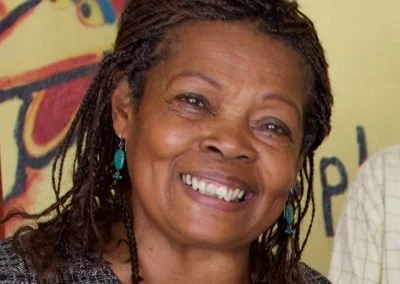
Merrice Crooks
Can you tell me about the Right to Read scheme and your role to help immigrant children to read
MC:
In 1975, the government set up what they called a Right to Read scheme, because they discovered there were about two million people who had problems with reading and writing—either because they didn’t go to school, or because, in that age, because of the war, their schooling was quite short.
So they set up this scheme which involved the whole country. All local authorities had to set up local facilities to help people who had problems with reading and writing. And all over the country, including Birmingham, there was a television programme to accompany the launch, the publicity, and the way they arranged it was for tutors to go into people’s homes and teach them—one-to-one. They trained tutors to go into homes and teach reading and writing to people with difficulties.
That’s where I came in. I was employed by the Birmingham Settlement to promote reading and writing, to recruit students and recruit teachers, and train them to go and teach students.
Teaching took place mostly on a one-to-one basis, but also in groups. Local authorities liaised and were involved in training, but voluntary organisations—like WELD, AFO, Harabi, Citadel, and the Settlement—ran their own provision. I was part of the Settlement, and I liaised with groups like AFO and Harabi.
I hadn’t done any teaching at first, but I did teacher training and, after my training, I was able to train other teachers as well to go out and teach. That was my first entry into the community. I did that for two years.
What happened after those two years?
MC:
After that I left and went to work with Handsworth Alternative Scheme—HAS. This was a new Black group of workers, mostly young Black graduates. We were supposed to work with the probation service and the law courts to work with young Black offenders, and to divert them from custody.
At that time, there was community service—when you go to court. Kids were arrested—Black and white—but Black kids were treated differently. They weren’t so quick to send Black kids to community service. The idea was that a group of Black workers—Black project workers—would better understand young Black people in Handsworth.
We tried to help young people who were offending, or at risk of offending, with advice on employment, housing, and education. My area was education. I would make sure they knew about colleges and facilities available, and what they could do.
But what we found was that significant numbers of people coming through HAS—people being picked up through the courts—couldn’t read and write very well, because most of them—around ninety per cent—left school without certificates and without literacy skills.
So I started by setting up reading and writing classes on the HAS project. One of the problems was that the schools they had attended had no Black teachers at that time—no Black teachers in schools. And many of the young people I spoke with who had “failed” said one of the reasons they didn’t learn to read and write was that there weren’t any materials about them—nothing in the curriculum—and racism in school meant no books or materials reflected their lives. And there were no Black teachers.
So I set up teaching projects at HAS that employed Black teachers. I went to churches, who were very helpful, and asked through churches and through education departments. I phoned Black people who could do teaching and I trained them to teach at HAS.
Where did the materials come from?
MC:
There were no materials at the time—nothing for them. No history books, no basic reading materials. So I set up—funded by government—funded by the Literacy and Basic Skills Unit—to produce materials, including Black history materials. They became very popular.
The materials were tested. We selected projects all over Birmingham—voluntary and statutory education projects—to monitor the materials for us.
We also produced a magazine—because we didn’t have Black magazines then. This one was based on a women’s magazine style. We wanted something attractive, something young women would want to pick up, which would motivate them to read, and which presented Black people in a different light.
The magazine was produced through contributions from Handsworth women. All the articles and content were about Handsworth. We also produced a Black history tape-slide programme, to inform young people about their history, because they were lost. There was no internet. Many weren’t confident to go to libraries, and books on Black issues weren’t there anyway. They had no heroes at school. We wanted to produce positive images.
What did the work develop into?
MC:
We started as community publishing and developed into self-financing. We bought a building in Hockley—Handprint—at 9 Key Hill Drive.
Later, more people joined, and Ten.8 moved in with us as well, so there was a whole media thing going on.
Handsworth Alternative Scheme had been based at Handsworth Cultural Centre. We were based there too. That was a key place in Handsworth. It was where Prince Charles and Princess Diana visited—Bob and a probation officer helped organise that visit—so Handsworth Cultural Centre mattered.
After that, we made an application to the Economic Development Unit. The council structures were different then. The Economic Development Unit helped voluntary sector projects develop self-financing. They supported us as a self-financing project.
Once we became self-financing at Handprint, we not only produced our own materials, but we produced materials for local organisations as well—annual reports for groups like Harabi and others. It also became a training facility: we trained young people to work in media.
Handprint closed at the end of the 1990s. We couldn’t carry on—funding wasn’t available and there was a financial crash. When we produced materials, organisations bought books from us, and the crash meant people lost money. We lost money and couldn’t continue.
After that I went to work for City College. I did postgraduate training. I continued working in Handsworth through Handsworth College and later City College.
You’ve also sent books to Jamaica, haven’t you?
MC:
Yes—thousands of books to Jamaican schools. That’s one of my favourite projects. Books are very expensive in Jamaica. Only high schools tend to have a small library. I set up libraries in schools. The children were so pleased to see the books.
Birmingham libraries gave me many books. They would get new books and get rid of old ones, and they gave me a lot of those older books, which I sent to Jamaica. I haven’t sent anything since the pandemic, but I’m getting books together again.
When you were setting up the curriculum for teaching, where did you get your ideas?
MC:
Adult literacy is different from teaching children. Children are developing vocabulary. Adults already have vocabulary—they know what they want to say—but they can’t read and write it.
The Right to Read approach was to start with the students’ interests. The tutor would find out what the person was interested in, and then gear the material to that. For example, if someone was involved in church, you use that. If someone was interested in gardening, you build material on that. I had a lady planting up her kitchen garden, and we made materials on plants.
So they tell you what they’re interested in; you write it up and use it to teach them. It’s student-centred.
Were you influenced by political writing as well?
MC:
Yes, absolutely. That’s where Black history materials came in. Many young people had no knowledge of slavery or where they came from. We started with slavery and the Atlantic slave trade. We looked at Black heroes. We wanted them to know there were people in history who fought against slavery and fought to overthrow the slave system.
We focused particularly on Jamaica as well—showing towns and cities, industries, ordinary people—because many young people only had distorted images. They thought of “mud huts.” We wanted to show modern life and positive images: markets, shopping, office work, science—basic things they hadn’t expected to see.
The Home Office bought 2,000 copies at one point. When we worked with probation and even went into prisons, there was a large population of young Black boys in prison. They would get the books. Some came to find me afterwards—“the lady who wrote the Rocky books.”
How did you get involved with WELD?
MC:
When I worked at the Settlement, tutors across literacy projects met once a month. People knew me through that. One of the tutors who worked at WELD said I should come to WELD and teach her group. I taught the group for three years. Even after I left, I continued because I really liked them.
We produced a little book together—All Hands Together. The grant came from the Community Relations Council. They gave £50 to print it. The book involved a lot of recording and typing: tape it, type it up, play it back, correct it, and correct it again. That was my first publishing experience.
The learners were proud to see their writing in a book, especially while learning to read and write. The drawings and illustrations were done by people in the group as well.
We launched the book in Parliament. Many of the learners had never been to London. An MP can book a room for free; we just had to cover fares.
Handsworth sounds like it was very connected then.
MC:
Handsworth was vibrant in the late 1970s and 1980s. There were many projects. You could move from AFO to Harabi easily. You’d meet people in meetings, in shops, everywhere. There was a lot going on before the riots.
Handsworth is important to me. It was my patch: Aston, Handsworth, Lozells. I still feel a strong connection.
I was recognised through a community coin project linked to Soho House Museum. Arts Council England funded artists-in-residence to bring people into the museum. They invited nominations for people who had done significant community work and put it to a vote. Three people were selected, including me. Coins were produced and given to schoolchildren and local people; you could use the coin for museum entry.
How long did it take to make All Hands Together?
MC:
It took time—several classes. Probably four to six months altogether, including fundraising walks, getting the writing together, and printing. You need patience. People took time to write, to correct, to practice. It was student-centred learning, and it was different from school where they felt teachers didn’t listen.