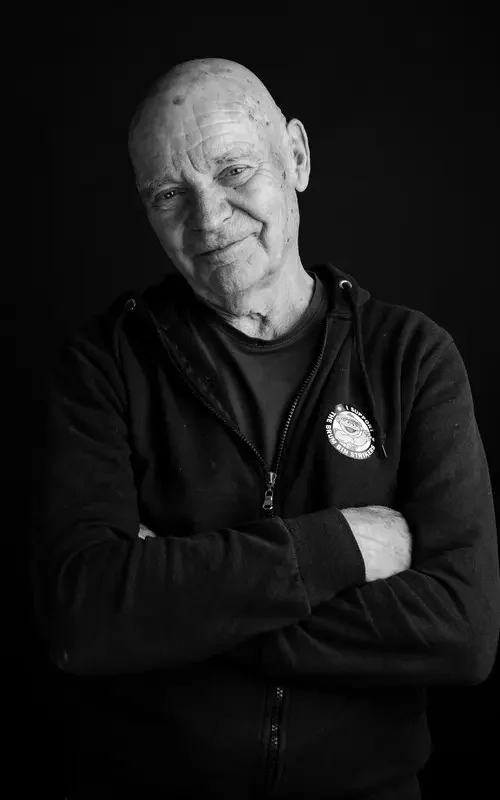
Dave Rogers
Interviewee:
In 1973—we did Collier Laddie—and then we decided, “Let’s make a theatre company out of what we’re doing.” So in 1974 we started properly—doing political theatre. All of it was people volunteering their own time, including Charles, who was obviously central. We didn’t get any funding until the late 1970s—1979, I think—when we got a kind of outreach worker post.
Interviewee:
We worked in Handsworth, running workshops with young people at Holyhead School and elsewhere—doing work around race and related issues. There was one group that did images and a series—over a number of years—around the local community. That was the first time there was funding, so people got paid for doing that. But up until then it had all been voluntary.
We’d turn up for a gig in four or five cars, with a trailer full of gear—two scaffolding towers for the screen and everything.
Interviewee:
People had jobs and did it in their spare time. I was a computer programmer at that point, and then I drove an ice cream van.
It’s interesting—recently we had a woman called Kamita come over from Delhi. She works with a company called Janam, a political theatre company in Delhi that’s been going since exactly the same time as us—fifty years of political theatre. None of them get paid ever; they don’t take state funding. To keep that going for fifty years is amazing. And they’re seriously political—one of their founder members was killed, around a strike in Delhi.
I wrote a song about the Indian farmers and she got it translated, and they performed it at a mass rally in Delhi—hundreds of thousands of people. Banner goes global. It was a farmers’ rally because Modi is reneging on promises after the general strike. Anyway, that’s a digression—but they’re a really interesting group.
Interviewee:
So that was the birth pangs of Banner Theatre, really. We did an amazing amount of work in those early years, considering everybody was working and doing it voluntarily. We didn’t have kids at that point, so we had time.
Interviewee:
I mean, the centre of politics came from Ewan. He’d been involved in the Communist Party, then left, became more Maoist, and was critical of the Communist Party. He did “theatre of action” in the 1930s.
Charlie evolves. Ewan’s line would be that Charlie wasn’t always politicised—more Christian in the 1950s—but by the time I worked with him in the 1970s he was clearly on the left. He’d been to China, and so on. Ewan politicised Peggy—Ewan’s biography and autobiography make that clear. They were in the background and did workshops with us.
Interviewee:
Joshi was a big influence—really important. He had the bookshop in Selly Oak and there was a whole network around him. When we did The Great Divide—our anti-racist show—we went to Josh and said: “Look, we’re white folk-based; we need guidance.”
He introduced us to Ijaz—who later became central to the Pakistani Workers Association. A good friend and comrade for many years. He died two or three years ago. The Pakistani Workers Association were our best mates.
Joshi was linked to the Thompsons and that network—George Thompson and Catherine. He was well connected across the trade union movement. Everyone on the left from that generation talks about Joshi. His partner Shirley was a key figure too—she taught at the same university as my wife, who died three years ago. I sang at Shirley’s funeral.
Key figures in the anti-racist movement for me would include Ijaz (Pakistani Workers Association), and people like Mokhtar and Bilou—youth movement—and obviously Joshi. He read our work and gave comments. That kind of relationship mattered.
Interviewee:
We did the community project in Handsworth. We did a show called The Great Divide—based on interviews with anti-racist activists and Black, Asian, and Afro-Caribbean people. We had a mixed-race ensemble.
In the early days Banner was rooted in English folklore—very white. So we had to do work to bring Black and Asian performers into the show, and write songs that made sense for a mixed-race ensemble.
The show toured extensively. It was essentially amateur—no one got paid. It took a big team effort: we’d build the projection screen from scaffolding towers. There was no PA system at first—we had to work acoustically. We learned our craft in the 1970s.
Through the late 1970s and early 1980s we started getting grants and we could sometimes pay ourselves—but then Thatcher got her teeth into it, and it all went. Then we were back to signing on.
In terms of anti-racist work, in that period it was mainly The Great Divide and the Handsworth project. We also did other shows that were anti-imperialist: Chile and the coup; Vietnam and the struggle.
I think The Great Divide was around 1977. I have notes here: “Show on racism in conjunction with the Indian Workers Association. Anti-fascist show written in collaboration with the IWA. Performed at an International Arts Festival in Berlin.
Interviewee:
We came out of the folk tradition, strongly influenced by Parker and MacColl, and the power of working-class speech. We were focused on working-class culture: how people tell stories, the language people speak. We used interview material verbatim—spoken on stage.
At first we worked with the spoken word. Later we introduced audio. We were also influenced by mumming traditions and street theatre—trying to develop a form that carried English cultural traditions forward, but also drew on performance traditions.
None of us went to drama school or music school. We learned as we went. Roma had a theatre background—she later became a drama teacher at Holyhead School—and she directed some of the work. It was democratic and improvised, learning-by-doing.
In the 1970s, the politics was whatever was urgent at the time: working-class struggles, building workers, miners, Saltley Gate, mass pickets. We moved those struggles into shows. Anti-racism was part of that, but the main explicit work was The Great Divide. Later we developed work around refugees and asylum seekers.
There’s hardly any archivist left there now. I’m nervous about our archive being there. We’ve got the past twenty years of interviews—fifty years of interviewing people. We never thought of it as “an archive”—it was just: do twenty interviews for a show, throw them in a box, move on.
Recently someone working with us on the fiftieth anniversary said we need a proper archive—it’s a heritage issue. The early stuff has been digitised by the library, I think. But the more recent material—recorded digitally on mini-discs—needs backing up. It’s a massive job.
Interviewee:
Saltley Gate was the first one I got involved in—the miners’ strike in 1972. We had hundreds of hours. At first I thought: why can’t we just write something? But after a while you realise it’s powerful—actuality. And then to play it live in performance—seeing people recognise themselves—that’s another level.
Interviewee:
I can only speak for Banner—we weren’t “the movement,” just a small part. But there was enough empathy between political elements in the Afro-Caribbean and Asian communities to see anti-racism as a joint project.
When the riots kicked off in the 1980s, “Black” was a political colour—no doubt. There was a moment on the Soho Road when the word went round that the police and National Front were going to march into Handsworth. Everybody was out—Black, Asian, and even a few white people. You could hear the drums down the street. That unity of purpose felt solid then.
Interviewee:
For us: we wrote about the riots, police violence, and so on. Beyond that, I don’t know if there was a coherent wider cultural movement. There was political reggae, certainly. There were left theatre groups—7:84, Belt and Braces, women’s theatre groups—and a working-class touring circuit: working men’s clubs, community centres, not arts venues.
But I don’t have a sense of one coherent cultural “movement.” Banner did its own thing. We were integrally involved in struggles—miners, pickets, fundraising, interviews, performances—but I can’t say masses of others were doing the same.
Interviewee:
Yes, pockets. Jeremy Deller did the Mansfield stuff—that’s recorded. But the marginalisation of working-class culture is systematic. We did a 50th anniversary show about Saltley Gate and most schools have never heard of it. It’s a deliberate cultural erasure.
We say in the show: after 1972 and 1974—miners winning, bringing down a government—Ridley’s report planned confrontation with the unions. It was planned: militarised policing, intelligence operations. The miners’ defeat paved the way for neoliberalism: privatisation, welfare retrenchment, immiseration. The NHS is being dismantled deliberately. [The interviewee digresses into contemporary politics and returns.]
Interviewee:
There was a radical community arts tradition in the early 1970s. For example, we occupied a big cathedral-like building on Camp Hill—thinking we could turn it into a massive community arts centre. We were concreting floors and boarding windows. Around the same time, the MAC was emerging—more establishment—so our vision wasn’t going to happen.
We worked with groups like Corby Community Arts, Jubilee Arts in West Bromwich (very different then—community-based), and a Community Arts Network. Groups would meet, perform, critique each other, and learn by doing. During the People’s March for Jobs, Jubilee had a double-decker bus: we’d pull out a PA system and perform as marchers arrived in towns.
But over time the movement became depoliticised and “nice”—it lost the rawness of the 1970s. Equity became involved too, unionising people who weren’t from the National Theatre / Royal Opera world.
In the 1990s and 2000s we did major anti-racist work, including a show developed with firefighters and the Fire Brigades Union. We interviewed Black firefighters about everyday racism, performed in fire stations, then held discussions chaired by union Black sections and management.
That current conversation about racism in the fire service—this was twenty years ago, and it keeps coming back.