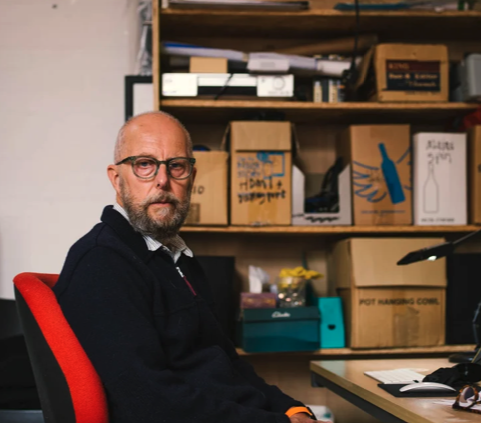
Roger Suckling
Transcript: Interview with Roger Suckling
I started working a community artist, but I wasn’t libelled one because I was a photographers. I started photography with John Birdsall. John ran socialist photo library for years. He sold it a while ago and someone else runs it now. When he was thinking of setting something up, I went with him to London to meet Simon Guttmann, who supplied photographs to Red Star, the socialist newspaper. His office was tiny, filled with piles of newspapers. He said, “I’m not going to talk about the Leica,” and then spent the next few minutes explaining how the Leica changed everything, its portability, its small format, and the quality it allowed. He was a real camera buff.
John and I set up a darkroom in Nottingham when we started. We ran classes so people could learn the technical processes needed for photography at the time. We supplied photographs for local newsletters and newspapers and documented community events. There were several community artists who worked mainly in Hyson Green and produced murals, most of them involving local residents and children. One mural by Ray Richardson, “the first men on the moon”, was painted on the Hyson Green flats before they were demolished.
The Hyson Green flats were a important cultural centre for local residents. Underneath the flats were garages that were converted into workshop spaces for tenants. I made a video about it, spent days editing it. I gave them a copy, and when I went back a week later they told me they had taped over it with Coronation Street. I didn’t have another copy. The Nottingham Community Arts Centre later became known as the Exchange Arts Group, which is how New Art Exchange took its name. When I was there, we rented a room to an Asian arts group, connected to Parbinder and others, which went on to develop the Nottingham Mela. I think the Mela grew out of their relationship with the Community Arts Centre.
I lost touch with people after about 1981. There was someone called John Waller and Diane Bowling, who now runs a bookshop in Wales. She was involved after I left. John was more of an administrator than an artist, but he ran the centre for a while. He’d have interesting insights into the links between the centre and Asian arts groups. Diane might too. I mentioned a woman called Martha, one of the community artists. I can’t remember her surname. I’ve been in occasional contact with her. She went into social work, but she remains very knowledgeable. She came to the recent Self-Portrait event at New Art Exchange and brought people with her, including the artist Warwick Williams, whose father has work in Tate Britain’s Caribbean artists exhibition. Martha knows many of the people from the Black community who appeared in the Self-Portrait series.
At that event, they also brought a woman who used to be Chief Executive of Tomlinson Housing. She said she was the one who pressed the button to demolish the Hyson Green flats. The meeting ended up being mostly them reminiscing about blues parties and weed, not what the organisers expected, but it was enjoyable. There are still people around who remember that time and who were deeply involved in the Black community.
There was also Harminder Singh, who attended the photography courses. Another participant was Pete, a young Black man then, who photographed himself for the Self-Portrait exhibition. I can’t recall his surname.
I wasn’t’ really involved in anti-racism work, though I did photograph some anti-racism activity and graffito in Leicester, and it was everywhere. I told you about Martha being refused service at the ALMA pub. We couldn’t believe it when it happened, so race and racism were topics we discussed, even if they weren’t part of a formal anti-racist role.
Interviewer : When you say socially engaged, do you mean photographers documenting issues, or residents participating in the work?
Roger: Both. The Self-Portrait project grew from that idea, giving agency to individuals rather than having outsiders represent them. It was about enabling working-class and local Black and Asian residents to have a voice and be seen as legitimate subjects in art and culture. There were also screen-printing workshops, murals, and other skills-based activities.
All of that was positive—giving people skills and opportunities they wouldn’t otherwise have had. I was never convinced about the rhetoric of community building. It felt like we were being brought in by government bodies that had failed the community and didn’t know how to address the underlying issues. A few weeks after the Self-Portrait photographs were taken, in June 1981, there were riots in Hyson Green, behind the Community Arts Centre.