
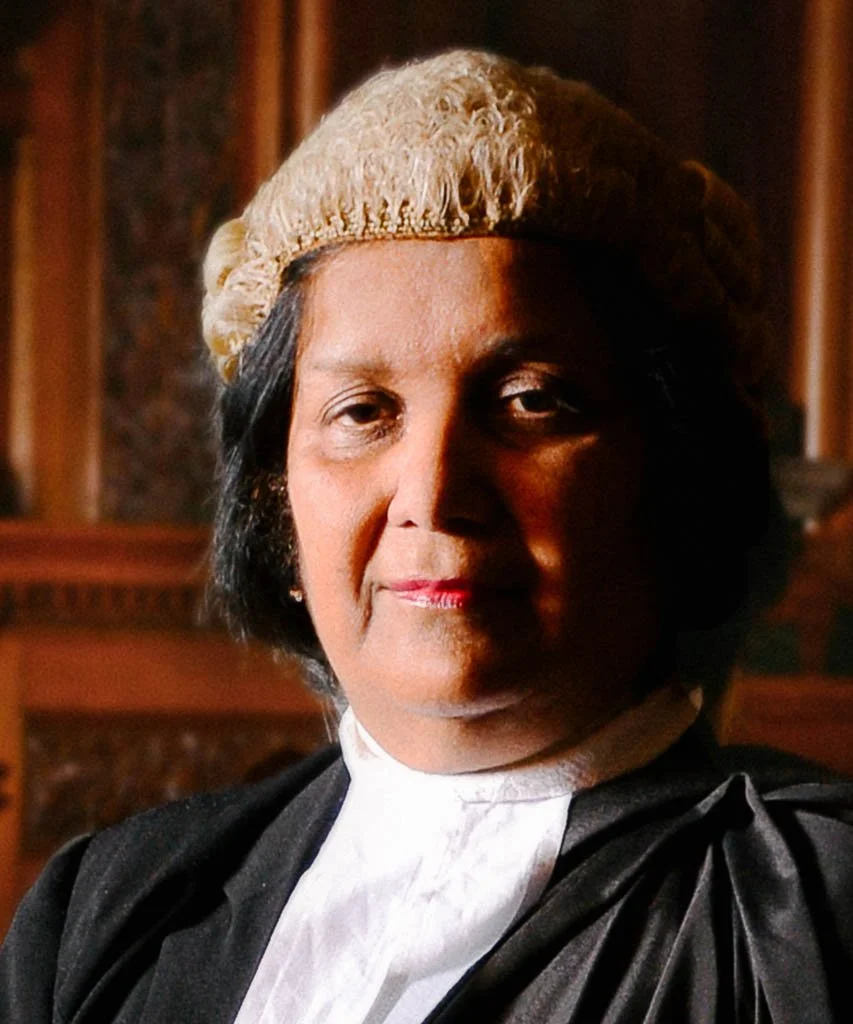
Usha Sood
Usha Sood
Could you tell me briefly about your family background, and how that has influenced you?
Usha Sood: My father came from Malaysia in ’69. He was Assistant Commissioner of Police there, worked in intelligence. He trained here (UK), etc. I was inspired by him to pursue law. My family has photographs from his early career, police training in UK, etc. My brother is now helping to salvage and document some of those archives. I’ll try to provide some for your project.
You also mentioned Asian history activism and local history. Could you tell me more?
Usha Sood: Yes. I want to write and log the history of Asian activism here. Black activism tends to be better documented; Asian activism is often neglected. We are going to hold a small exhibition for a week, with a walk‑and‑talk. It’s modest, but it's a step. I’d like to do something bigger next year. The Council runs many events during Asian History Month, but very few are about history or activism — mostly cultural.
What happens when you don’t have the means to provide expert reports?
Usha Sood: Just the other day, I went to court for a family, and the Home Office evidence was just headings from certain organisations. They’d gone online and picked things like “Swedish workers willing to help with disabled children in Nepal.” There was the heading — but not the actual document. And the judge was being asked to treat that as proof that Nepal is getting help for autistic children. I had to provide my own material.
At that stage, we didn’t have the funds to hire an expert. But now we have put his case on a crowdfunding site. Worst‐case, if it’s not successful in court, my client would be able to make a fresh application with an expert’s view. The costs often arise not just from legal fees but from gathering convincing evidence to show that the Home Office is wrong. In many immigration cases — including those based on experiences abroad or regularising status here — the key to success is expert evidence.
These experts charge between £500 to £2,000. How is a woman in a forced marriage, or an honour‑crime situation, or one trafficked in a sham marriage, going to find that kind of money?
So how do you cover those costs when the client can't?
Usha Sood: I rely on public goodwill a lot of the time. We appeal to funding organisations like Change.org, Crowd Justice, etc. I’ll say “Look, put this case on the platform, let’s see how much we raise.”
In one recent case with a Pakistani Christian woman, a church came forward, and they raised double what was asked within a week. Because of that, we could get expert reports and give her a much better chance. There is goodwill out there — sympathetic people — but it tends to be inside smaller networks rather than broad societal awareness. Often the general mood toward immigrants is “we’ve got our own problems, we don’t need to take on somebody else’s.”
What kind of outcomes do you see when cases proceed well, and how do you train others?
Usha Sood: Over forty years, I’ve noticed that nationally, success rates in our field are about 5‑10%. But in our chambers, the success rate is about 70‑80%. That tells me we’re doing something right, from the heart, and with skill.
I believe strongly in legacy. The people I train are getting basic skills now being refined: knowing what documents a judge will expect, what experts to instruct, how to build a strong case. They are learning a template for success, which helps our clients.
Who are the local leaders or archives that you think are worth investigating?
Usha Sood: Joginda Singh Prem: a Sikh police officer who won a race discrimination case in the ’70s. He should still be around, and features about him appeared in the Nottingham Evening Post. Archival photos of my cases or of local activism: I’ll try to secure those (newspaper clippings, photos). “Fakey” family (Vinene Fakey) of Midland Trimmings: family who came in early migrants in the ’40s. They have old homes, photos, family history. Bilku family on Woodborough Road: had one of the “welcome houses” used by migrants.
Are there cases you’re working on that push legal boundaries?
Usha Sood: Yes, there are two at the moment:
A Sikh woman who was brought from India under a forced marriage, but she was also studying. She challenged her situation after suffering abuse; this is the first time trafficking is being argued within a forced marriage context. A Pakistani woman married off to her cousin (sexual abuse case), without being told her husband was homosexual. Both cases are novel legally and test how the law treats trafficking and forced marriage.
What do you think about how institutions remember or represent these legal / activist histories?
Usha Sood: Often not well. For example, the Galleries of Justice here don’t fully capture the struggles of Black and Asian communities in legal settings. We need more visible timelines, exhibitions, public displays: the “journey to justice” for Asian and Black communities. Things like the House of Lords battle over turbans at work could be included.
The law can only do so much; but when cases succeed, when histories are preserved, people feel seen. I believe in passing on skills, in building evidence, in mentoring. I hope that this work continues beyond me, becomes part of what the community values and remembers.