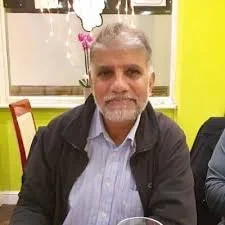
Parbinder Singh
Parbinder Singh
SECTION 1: Early Life, Family History, and Migration (1940s–1970s)
Q: Can you start by telling me a bit about your family background and early life?
A: My father came from Punjab, from a small village. He went to Kenya in his early twenties, in 1947. Something happened during Partition – or something made him leave India – and he moved to Kenya where he got a job on the railway line in 1949. He worked there for a while, then went back to India to bring my mother to Kenya, and they settled on the shores of Lake Victoria.
Q: What was life like for your parents in Kenya at that time?
A: My mother arrived in Africa with nothing. She was young and living in the married quarters of the railways, and she was lost at first. Then they were “adopted” by a Hindu family, the Sharmas, who also adopted a daughter. They built a life around that family unit. My father had a brother in Nairobi, but he had little to do with him.
Q: When and where were you born?
A: I was born in 1956. A year later, we were all taken back to India, but they felt it was too much to take all the children on the steamer, so one older brother was left behind to live with the Sharma family. In India my younger brother was born. We came back over a year later, in 1958. Around 1961 we moved to Kampala, then in 1964 to Nairobi. In 1967, we came to the UK. I didn’t know why we were coming – I was only 10 – we just went along with things. Somehow we ended up in West Bridgford, Nottingham.
Q: Looking back now, what do you understand about the reasons for that move to Britain?
A: Only now do I understand why. We came to get out before the borders were closed. Luckily, my father had taken British citizenship in 1957. He had to apply for it – it wasn’t given to him. Because he worked on the railways, that helped him get British nationality. Now I realise this was all connected to the Kenyan Africanisation process and the 1968 Commonwealth Immigrants Act. Most people had to come here through a grandparent, vouchers, or jobs. Jomo Kenyatta’s policies pushed people to take Kenyan citizenship. But because my father worked for the Crown, we had other options. That’s why he rushed to bring us here in 1967 – before the 1968 Act came into force. It was a Labour government that passed that law.
Q: How did that affect your family?
A: It was complicated. My father knew he had no future in Kenya once he took British nationality – he worried he’d become a refugee – so he decided to move to Britain. He couldn’t go back to India either. My younger brother had been in India since 1957, and we couldn’t get him at first. We didn’t see him until 1971. My father had to travel to India to collect him so his human rights wouldn’t be lost. But because my brother was born in Kenya, he was effectively stateless. My father had to take him from India to Kenya, and then to Britain. It was a tense time. Different members of the family were treated differently by immigration systems. It’s scary because even now someone could ask us to “prove” our nationality. Luckily, my father kept all the documents with the immigration stamps. I still have them.
Q: What do you know about your father’s background and aspirations?
A: My father was good at education – he went to metric level, which was a high standard at the time. Education was respected. He could write good Punjabi, Urdu, and English. He wanted a white-collar job. But getting work wasn’t easy. He had to bribe someone for a job – that’s how the system worked. When we came here, I could already speak English. In Kenya we spoke English all the time – education there was very Anglicised.
Q: It sounds like your family moved around a lot.
A: Yes, we did. My brother was born on the shores of Lake Victoria, my sister near Mount Kenya, another sibling in India, and another here in the UK. The UK became the thread that connected the family. My father knew a friend of the Sharmas in Nottingham who told him to come here. We lived in their house in West Bridgford for a while. We were a large family – two brothers and one sister older than me, and two brothers and one sister younger. Bringing up a family like that here was tough. My brother Manjeet wore a turban to grammar school – I don’t know how he got admitted. I had to go to Musters Road Secondary School because that’s where they told new arrivals to go.
Q: How were those early experiences in Britain?
A: Everything was hostile. In Kenya, people were rushing to get passports and documents ready because of the two-year rule after independence – people had to choose Kenyan citizenship or not. With Africanisation, no one knew what to trust. But when we came here, people were racist and hostile. It was tough. This was all the legacy of Empire. People don’t realise this – it’s why Asians had to come here, and also why we were in Kenya in the first place. We were needed by the Empire.
Q: What did your father do once you were settled in Nottingham?
A: At one point he considered leaving us here and going back to work for the Crown railways in Kenya. But he managed to collect his pension without doing that, and stayed with us. He started working at Raleigh’s like many other Indians – a clerical job in the wholesale division. Later he moved to Boots. Boots was one of the more progressive employers in the city – one of the few places with Asians in key positions. He stayed there until he retired.
Q: What was your own experience of school like?
A: My schooling wasn’t great. I went to a modern secondary school rather than a grammar school. Back then, that determined your place in society. Few of us did GCSEs – only CSEs – and it was basically training for factory work. It was often very racist. I remember a geography teacher making comments about where I came from, saying it was inferior or different. But I got involved with the open film society at school, which was an important part of my life. It was in the disability centre at the back of the college. We got films from distributors and showed them on a 16mm projector, once in the afternoon and once in the evening. They were popular – not Indian films, but mainstream ones. We borrowed films from the BFI, sold tickets, and screened them. It helped me fit in, because Asians weren’t popular. It was a way to socialise.
Q: What happened after you finished school?
A: I left school in 1975. I hadn’t really left West Bridgford before then. It was a tough time for immigrants. I went to school, did a paper round to bring in money, and worked at Boots in the holidays. Later, I went to Bradford University to study chemistry. That’s where everything changed for me.
Political Awakening, Bradford, and the Asian Youth Movement (1970s–early 1980s)
Q: What was it like when you arrived in Bradford as a student?
A: Bradford was a complete shock. I’d never been in a place like it before – it was gritty, working-class, industrial, and radical. There were lots of Irish people, a strong trade union movement, and a political culture that was different from anything I’d experienced in Nottingham. It was the first time I really saw racism organised – by the National Front, by landlords, by employers. But I also saw resistance. People were organising against it.
Q: How did you first get involved in political activity?
A: It started small. I joined the students’ union, then the anti-apartheid group, then the Anti-Nazi League. The National Front were active on campus and in the city. They’d put up posters saying “Keep Britain White” or “Send them back.” They held rallies. I’d never seen that level of organised racism before. There were street confrontations – marches, counter-demonstrations. It was scary but also energising.
Q: Were there particular events or incidents that politicised you?
A: There were a few. One was the murder of Gurdip Singh Chaggar in Southall in 1976. Another was the attack on the Indian Workers’ Association building in Southall. These were wake-up calls. We realised the state wasn’t going to protect us. The police were often on the side of the racists. That’s when we started to talk about self-defence, about the need for Asian people to organise independently.
Q: How did the Asian Youth Movement (AYM) come into that picture?
A: Around 1977 or 1978, young Asians in Bradford – mainly from working-class backgrounds – started meeting informally. We felt that older organisations like the IWA weren’t representing us. They were more about petitions, lobbying, and community centres. We wanted direct action. We were influenced by the Black Panthers, by Malcolm X, by Angela Davis. We were reading The Autobiography of Malcolm X and George Jackson’s Soledad Brother. We were also learning from the Black People’s Alliance and the 1960s anti-colonial struggles. Out of those meetings, the Asian Youth Movement was formed.
Q: What were the AYM’s aims and methods?
A: We were clear: we were anti-racist, anti-imperialist, and socialist. We believed in self-defence and solidarity. We believed that Asians and Africans had a shared struggle against racism and capitalism. We called ourselves “Black” politically – not because we were trying to be African or Afro-Caribbean, but because “Black” meant all those fighting against racism and colonialism. That was a big shift. It wasn’t about biology, it was about politics.
We organised demonstrations, pickets, and sit-ins. We printed leaflets, held public meetings, and produced a newspaper called Kala Tara. We did legal support work for people facing deportation. We built alliances with Irish groups, trade unions, feminist groups, and anti-apartheid campaigns. We didn’t wait for politicians to act – we acted ourselves.
Q: Were there moments that stand out from your time in the AYM?
A: The first big one was the Bradford 12 case in 1981. Twelve Asian youth were arrested for making petrol bombs to defend the community against a National Front march. They were charged with conspiracy to cause explosions. It was a turning point. The police and press portrayed them as terrorists, but they were just defending their community. We organised a huge defence campaign – rallies, benefits, legal funds. It became national and even international news. When they were acquitted, it was a victory for all of us. It showed that collective action worked.
Another big moment was resisting deportations. People were being picked up from their homes, detained, and deported without due process. We would organise dawn vigils outside people’s houses, or we’d go to the airport to stop deportations. Sometimes we succeeded, sometimes we didn’t. But it politicised a whole generation.
Q: How did these experiences shape your understanding of racism and resistance?
A: It changed everything. I stopped thinking of racism as just about prejudice or ignorance. I saw it as structural – built into immigration laws, policing, housing, and employment. The Sus laws were used to harass Black and Asian youth. Housing officers would segregate people. Immigration officers would split up families. Racism wasn’t just about individuals shouting abuse – it was systemic. And the struggle had to be systemic too. That’s why we saw ourselves as part of a global anti-imperialist movement.
Q: What was the relationship between the AYM and the wider left?
A: It was complicated. Some socialist groups supported us, others tried to control us. We didn’t want to be anyone’s junior partners. We were willing to work with the SWP, IMG, or the Communist Party, but only on our terms. We were also critical of the Labour Party, which had passed racist immigration laws and supported police powers. We were independent. That was important to us.
Q: Were there cultural dimensions to the movement too?
A: Absolutely. Music, poetry, art – they were all part of it. We organised gigs, produced posters, and used film. There was a political theatre group called Asian Youth Movement Players that performed plays about racism and resistance. We held film screenings – documentaries about Vietnam, the Black Panthers, apartheid South Africa. Culture was a weapon. It wasn’t just about slogans; it was about changing how we saw ourselves.
Q: How did your involvement in the AYM come to an end?
A: It didn’t end abruptly, but by the early 1980s things were changing. Some people moved into community work, some into trade unions, some into education. The state had learned how to manage dissent – through funding, through multicultural policies, through new laws. Some of us tried to keep the radical edge alive within those spaces. That’s what I did – I started working in youth and community projects, trying to apply what I’d learned in Bradford.
Community Organising, Arts Practice, and Youth Work in Nottingham (1980s–1990s)
Q: What brought you back to Nottingham, and how did your political work continue there?
A: I came back to Nottingham in the early 1980s after finishing university. Bradford had radicalised me, and I wanted to bring that energy into my work. I started working with young people, first informally and then through more structured projects. There was a lot happening – unemployment was high, racism was still intense, and Thatcherism was tearing communities apart. But there was also a lot of creativity and determination.
Q: What kind of work did you do with young people?
A: I worked mainly in youth and community projects, particularly in inner-city areas like Hyson Green and Radford. We organised workshops on racism, identity, and history. We set up youth clubs, football teams, drama projects. We created spaces where young people could talk openly about their experiences and feel valued. A lot of them were dealing with racism in schools, stop-and-search by the police, and unemployment. We wanted to give them tools to understand those experiences politically – to see that it wasn’t their fault, that it was part of a bigger system.
Q: Was there a link between that youth work and your political activism?
A: Definitely. It wasn’t just about keeping kids off the streets. It was political education. We wanted them to understand imperialism, colonialism, capitalism – but in ways that made sense to their lives. We’d run workshops on where their families came from, why migration happened, why there were no jobs. We’d talk about the Black Power movement, the Asian Youth Movement, the miners’ strike, apartheid. We’d connect local issues to global struggles.
Q: Did culture and the arts play a role in that work?
A: Yes, a huge one. We used theatre, music, photography, and film as tools for political education. We put on plays about racism and identity. We made exhibitions about migration and resistance. We collaborated with artists and filmmakers. Culture was a way to bring people together, to make complex ideas accessible, and to celebrate our histories. It wasn’t “art for art’s sake” – it was art as a weapon, as a way to organise.
Q: Can you give an example of a project you were involved in?
A: One of the big ones was a youth arts project we did in the mid-1980s. It started with storytelling workshops where young people interviewed their parents and grandparents about their migration journeys. Then we turned those stories into a theatre production, with music and visuals. It was powerful – families came to watch, and people saw their stories on stage for the first time. It created pride. It also started conversations about racism and identity that hadn’t been possible before.
Q: How did the political landscape change during the 1980s?
A: It became more complicated. Thatcherism had broken the trade unions, multiculturalism was becoming state policy, and the left was fragmented. The far right was still around, but it was less visible. Instead, racism was becoming more institutional – through immigration laws, policing, education, housing. That made it harder to fight, because it was less obvious. At the same time, the state was funding community projects – which was good, but it also co-opted some of the energy. A lot of radical organisations became service providers.
Q: How did you navigate that tension between radicalism and working within institutions?
A: It was difficult. On one hand, you could reach more people and make tangible changes through funded work. On the other, you risked losing your edge. We tried to do both – to use state resources to empower people, while still challenging the system. Sometimes we succeeded, sometimes we compromised too much. It was always a balancing act.
Q: What do you think were the most significant achievements of that period?
A: I think the biggest achievement was building spaces where young people of colour could feel proud of who they were. We created a sense of history and continuity. We connected them to struggles that came before them – from anti-colonial movements to the fight against the National Front. We gave them tools to fight racism in their own ways. Some of those young people went on to become activists, teachers, artists, community leaders. That’s the legacy I’m most proud of.
Q: How do you reflect on that work now, looking back?
A: I think we did important work, but there’s still so much to do. Racism hasn’t gone away – it’s just changed shape. And the far right is still there, often in suits now instead of boots. But the lessons from that period are still relevant: that we need collective action, that we need to build alliances, that culture and education are powerful tools. And that we have to keep telling our stories. Because if we don’t, they’ll be erased.